Although I have essentially no formal entomological training, I have been involved in the describing and naming of many new insect species with various taxonomist collaborators, and I have recently begun describing new species on my own. Below is a complete list of the species I have authored or coauthored, followed by lists of other taxonomic changes that have been made in papers I’ve coauthored, and finally a list of other species whose original descriptions referenced specimens I collected (but which I was not involved in describing or naming). I’ve included brief notes about each species, and when available, the species name links to a blog post that goes into more detail. A list of the publications cited below can be found on this page, and I’m happy to share PDFs of them with anyone who is interested.
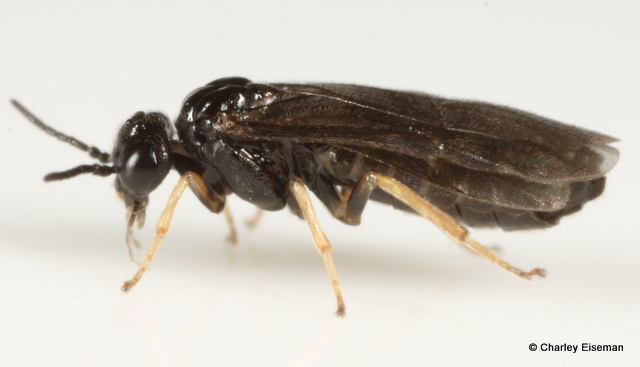
1. Scolioneura vaccinii Smith & Eiseman (in Smith et al. 2015) – A sawfly that mines leaves of huckleberries (Vaccinium spp.), which my wife Julia Blyth and I found in western Washington on our first cross-country trip in search of leafminers (though we only were able to rear parasitoids, and the type specimen was reared from a larva Noah Charney and his wife Sydne Record collected the following year).

2. Megaselia nantucketensis Eiseman & Hartop, 2015 – A scuttle fly that emerged from a midge gall on black oak, collected on Nantucket during the decade-long gall and leaf mine survey Julia and I conducted there starting in 2011.

3. Megaselia risoria Hartop, Wong & Eiseman, 2016 – The naming of this species was a byproduct of my having reared specimens of M. globipyga from a dead tussock moth caterpillar I found at work.
4. Platygaster pruni Buhl & Eiseman, 2016 – A platygastrid wasp that emerged from a midge gall on black cherry, which I collected at work one day in western Massachusetts.

5. Platygaster uvulariae Buhl & Eiseman, 2016 – A platygastrid wasp that emerged from a midge gall on wild oats (Uvularia sessilifolia)—again collected at work in western Massachusetts. I have since succeeded in rearing the midge that causes this gall; it belongs to the genus Meunieriella (Eiseman 2025).

6. Platygaster vitisiellae Buhl & Eiseman, 2016 – A platygastrid wasp that emerged from a midge gall on wild grape, collected as part of the Nantucket survey. The midge species is probably undescribed (but I was able to rear some adults, which are sitting in the Smithsonian waiting for someone to decide to revise the genus Vitisiella).

7. Zygoneura calthella Eiseman, Heller & Rulik, 2016 – A dark-winged fungus gnat that feeds in leaves and petioles of marsh marigold. Julia and I first found it while surveying for four-toed salamanders in western Massachusetts.

8. Fenusa julia Smith & Eiseman, 2017 – A sawfly that mines leaves of wild rose, which Julia spotted in Colorado on another leafminer-hunting road trip.
9. Marmara viburnella Eiseman & Davis (in Eiseman et al. 2017) – Another product of the Nantucket survey. The larva of this moth begins as a leafminer, then disappears down the petiole and spends most of its life feeding in the stem. Julia and I reared it from arrowwood, but mines have also been found on various other viburnums.

10. Platygaster tephrosiae Buhl & Eiseman, 2017 – Another one from Nantucket; I reared the two known specimens from midge galls that happened to be on some goat’s rue leaves that Kelly Omand collected for me to feed some leaf-tying caterpillars. I failed to rear the caterpillars, and I haven’t been able to rear the midge yet either.

11. Platygaster vaccinii Buhl & Eiseman, 2017 – The single known specimen emerged from a gall on lowbush blueberry that I collected at the 2016 Berkshire BioBlitz on Mt. Greylock—caused by another midge that has never been reared.

12. Macrosaccus coursetiae Eiseman & Davis, 2017 – Another one Julia and I collected on our first cross-country trip; this one from Arizona, mining leaves of a shrub called rosary babybonnets (Coursetia glandulosa).

13. Phytosciara greylockensis Eiseman, Heller & Rulik, 2018 – Another one from the Mt. Greylock BioBlitz; a dark-winged fungus gnat that was found mining leaves of bluebead lily (Clintonia borealis). I have since reared it from a variety of unrelated plants, always (unlike the original site on Mt. Greylock) along streams or in wetlands (Eiseman 2022).

14. Agromyza fission Eiseman & Lonsdale, 2018 – Owen Lonsdale had already decided to name this species based on a specimen collected in the DC area in 1914, but the type specimen is one Julia and I collected at MJ Hatfield’s “Red Oak Prairie” in eastern Iowa on the way home from Colorado. One of the paratypes came from a larva we collected the next day on Marcie and Mike O’Connor’s land in Wisconsin, and Mike Palmer provided two from Oklahoma. The larvae mine leaves of hackberry.

15. Agromyza soka Eiseman & Lonsdale, 2018 – This is another one that Owen had already named based on a 1914 specimen from the DC area, but as with A. fission its host was unknown. It turns out to be responsible for leaf mines on black locust that since 1982 have been attributed to Phytoliriomyza robiniae (Valley), adults of which were repeatedly associated with black locust but never actually reared. Some paratypes came from specimens Julia and I reared from larvae we collected at the 2016 Connecticut BioBlitz, and the rest came from larvae Tracy Feldman found mining both black locust and wisteria in North Carolina.

16. Melanagromyza palmeri Eiseman & Lonsdale, 2018 – Mike Palmer reared the type specimen from a sunflower stem (or possibly the roots) in Oklahoma. Stem-feeding members of this genus are borers rather than miners, meaning that they don’t form any externally visible trails. So rearing them takes special dedication and/or luck. In 2022, Tracy Feldman reared additional specimens in North Carolina from thistle leaves. On this host, the larva feeds in the leaf midrib, forming a narrow, sinuous, whitish mine that is visible on the upper surface (Eiseman et al. 2026).
17. Ophiomyia euthamiae Eiseman & Lonsdale, 2018 – This species mines leaves of grass-leaved goldenrod (Euthamia graminifolia), mostly on the lower surface. I first noticed mines like this on Nantucket, but those were possibly made by O. maura or O. verni; the whole type series of O. euthamiae came from my yard in Massachusetts.

18. Ophiomyia mimuli Eiseman & Lonsdale, 2018 – This species mines in stems of monkeyflower. I first found it at a bioblitz on Julia’s family’s land in southern Ohio, and some paratypes came from the swampy woods right behind our house in Massachusetts.

19. Ophiomyia parda Eiseman & Lonsdale, 2018 – Another species whose holotype I collected in my yard. The rearing of additional specimens provided a better picture of intraspecific variation, and this is now considered to be a synonym of O. quinta Spencer. It is a common leafminer of asters (Symphyotrichum spp.).

20. Calycomyza artemisivora Eiseman & Lonsdale, 2018 – This species is known only from two specimens I reared from leaf mines on Artemisia ludoviciana that Mike Palmer collected in Oklahoma.
 21. Calycomyza avira Eiseman & Lonsdale, 2018 – Another one that Owen had already named before I reared it; there are several specimens at the Smithsonian from Connecticut, New York, and West Virginia, dating back to 1929. The larvae mine leaves of beggar-ticks (Bidens spp.). I reared some from mines I collected at work, and Tracy Feldman provided some from North Carolina. More recently, this species has been reared from coreopsis in the Midwest (Eiseman et al. 2026).

22. Calycomyza eupatoriphaga Eiseman & Lonsdale, 2018 – This belongs to the same species complex as C. artemisivora. It has been reared from three plants in the tribe Eupatorieae: I found it on white snakeroot (Ageratina altissima) in Massachusetts and on blue mistflower (Conoclinium coelestinum) in Tennessee, and Mike Palmer found it on late boneset (Eupatorium serotinum) in Oklahoma. In teasing apart the members of this complex, Owen found a specimen that was collected in Ontario in 1947, which he included as a paratype. The holotype is from the woods right behind our house.

23. Calycomyza vogelmanni Eiseman & Lonsdale, 2018 – I reared the only known specimen from a leaf mine on thin-leaved sunflower (Helianthus decapetalus), which I collected near Burlington, Vermont, where I went to grad school. I named the species after Hub Vogelmann, who founded my graduate program (the Field Naturalist program). He had retired long before I attended, but he was very enthusiastic about my first book when it was published, and he was supportive as I got started on my leafminer book project.

24. Cerodontha edithae Eiseman & Lonsdale, 2018 – This species is an iris leafminer, the only known specimen of which Julia and I reared as part of our Nantucket surveys. I named it after Edith Andrews, who died in 2015, a day after her 100th birthday. She lived on Nantucket for most of her life and was an enthusiastic naturalist to the end. Birds were her main passion, but not long after Julia gave her a copy of my book, Julia went to visit her and found her and her daughter Ginger on their hands and knees in her driveway, getting a closer look at some wasp burrows. When I first met her, I was amazed at the memory of this nearly 100-year-old woman as she quoted from various parts of my book.

25. Cerodontha feldmani Eiseman & Lonsdale, 2018 – Another species known from a single specimen; in this case one I reared from a sedge leaf mine that Tracy Feldman collected in North Carolina. Tracy has been intensively collecting leafminers in North Carolina and elsewhere for over a decade and has found numerous new state records, new host records, and new species.

26. Liriomyza ivorcutleri Eiseman & Lonsdale, 2018 – I reared the holotype from a leaf mine on cup plant (Silphium perfoliatum) that Julia and I found in Iowa. When Owen told me this yellow fly was a new species, I couldn’t resist naming it after Ivor Cutler, the Scottish recording artist responsible for “Yellow Fly,” along with other classics like “I Believe in Bugs.” In 2021, Tracy reared this species from starry rosinweed (S. asteriscus) in North Carolina (Eiseman et al. 2026).

27. Liriomyza valerianivora Eiseman & Lonsdale, 2018 – I found the leaf mines of this species in a scrappy wetland in north-central Massachusetts where I was conducting botanical fieldwork with Sally Shaw. I was lucky she was with me, because I never would have recognized the basal leaves of garden valerian, which are totally different from those on mature plants. In 2020, John Klymko reared a specimen from the same host in Nova Scotia (Eiseman et al. 2026).

28. Phytomyza actaeivora Eiseman & Lonsdale, 2018 – I tried for several years to rear adults from leaf mines on red baneberry (which I’ve found in Vermont and Ohio) before finally succeeding with some mines I found on white baneberry in my neighbors’ woods. I also found mines of what is probably the same species on black cohosh (these are all Actaea species) at Jason Dombroskie’s house in Ithaca, NY, but these were all parasitized like the ones on red baneberry.

29. Phytomyza aesculi Eiseman & Lonsdale, 2018 – I first became aware of this species because of photos of buckeye leaf mines that several different people posted to BugGuide.net. One spring when Julia was visiting her parents in Ohio (the Buckeye State), she managed to collect a bunch of larvae, from which I reared the type series. This species is active only in spring, with a pupal diapause lasting nearly a year. The author of this article was grateful when I let him know that his mystery “buckeye leafmining fly” now has a name. I have since reared additional specimens from larvae Tracy Feldman and Jim Petranka collected in North Carolina (Eiseman et al. 2026).

30. Phytomyza confusa Eiseman & Lonsdale, 2018 – I named this fly “confusa” because everything about it was confusing. I found the leaf mines at the base of a tree in the middle of a lawn in a big park in Iowa. I tentatively identified the plant as Virginia waterleaf (Hydrophyllum virginianum), but it looked a little weird to me (not to mention that Virginia waterleaf is normally a forest species). Iowa botanist John Pearson suggested that it might be a buttercup such as Ranunculus fascicularis. When Owen initially determined the flies as belonging to a new species in the Phyomyza aquilegiae group, this seemed to fit, since all members of this group feed on plants in the buttercup family as far as is known. I showed my photo of the plant to several other botanists, and they all shared my initial impression that it was Virginia waterleaf, but most were also willing to believe it was Ranunculus fascicularis, and one even examined some herbarium specimens of that species that she said matched in every respect. But Owen later determined P. confusa to be closely related to another new species that I reared from two species of waterleaf (see below), and decided both flies probably are better placed in the P. obscura group, all species of which feed on plants in the mint and borage orders (waterleafs are in the latter). This species was also confusing because the leaf mines were hard to characterize—some began with a distinct linear portion and some did not, and by the time the adults emerged the leaves were so crumpled and degraded that I couldn’t decide whether the puparia were formed inside or outside the mines. John van der Linden and Mathew Zappa have since repeated the rearing of this species from Virginia waterleaf in Iowa and Minnesota (Eiseman et al. 2021, 2026), so so the identity of its host plant is no longer a point of confusion.

31. Phytomyza doellingeriae Eiseman & Lonsdale, 2018 – While working in Maine in July 2013, I collected leafminers from flat-topped aster (Doellingeria umbellata) that Owen determined to be a new species near P. solidaginivora Spencer based on the genitalia. Both of the adults I reared were underdeveloped (as shown here), so when I returned in August I collected some more. I reared some good specimens this time, but Owen determined them to be a different new species, which I named P. doellingeriae. Meanwhile, he decided the first flies were close enough to P. solidaginivora to call them that for now. Incidentally, Spencer (1969) reared P. solidaginivora from a plant in Alberta that he thought was goldenrod (Solidago; hence the name), but Graham Griffiths examined his pressed leaf mines and didn’t think they looked like any goldenrod that occurs in Alberta. Spencer’s drawing of the leaf looks exactly like a flat-topped aster leaf, so that fly is probably misnamed. I have since reared more specimens of P. doellingeriae from Massachusetts, and of P. solidaginivora from Vermont (again from flat-topped aster).

32. Phytomyza erigeronis Eiseman & Lonsdale, 2018 – I first found this leafminer of daisy fleabane (Erigeron) in my front yard. Some of the paratypes came from the 2016 Connecticut BioBlitz. Julia, Tracy, and I have since reared additional specimens from Wisconsin, Iowa, and North Carolina (Eiseman et al. 2026).

33. Phytomyza hatfieldae Eiseman & Lonsdale, 2018 – When Julia and I stayed with MJ Hatfield in northeastern Iowa on the way home from Colorado, we spent a little time exploring the woods on the bluff next to her house with MJ and John van der Linden. Leaf mines that we collected there on sweet cicely (Osmorhiza claytonii) yielded the holotype of this new species. The paratypes also included a number of specimens Graham Griffiths had reared from various Osmorhiza species in the 1970s, plus a few that Ed Stansbury reared in Washington just in time to be included in the paper.

34. Phytomyza hydrophyllivora Eiseman & Lonsdale, 2018 – This species is common on appendaged waterleaf (Hydrophyllum appendiculatum) in Ohio, and I collected the mines several times from the woods by Julia’s parents’ house before I finally got a few adult flies instead of parasitoid wasps. I later reared one from the same host in Tennessee (during our brief trip to see the solar eclipse in 2017), and one from a mine I found on Virginia waterleaf while conducting a rare plant survey in the Berkshires. MJ Hatfield and I have since reared additional specimens from Iowa (Eiseman et al. 2026), which means that the range of this species overlaps with that of P. confusa, which also feeds on Virginia waterleaf.

35. Phytomyza palmeri Eiseman & Lonsdale, 2018 – This is another species (like Melanagromyza palmeri) that was known only from Mike Palmer‘s yard in Oklahoma at the time of its description. Specimens have since been reared from Texas, Arkansas, and North Carolina (Eiseman et al. 2026). The larvae mine leaves of coralberry (Symphoricarpos orbiculatus).

36. Phytomyza palustris Eiseman & Lonsdale, 2018 – I found this leafminer of swamp saxifrage while conducting botanical fieldwork in the Berkshires. I check this plant for mines every time I see it, but all the mines I have ever found were within one square meter in the town of Washington, Massachusetts. However, Mathew Zappa has found mines of what is probably this species in Minnesota.

37. Phytomyza sempervirentis Eiseman & Lonsdale, 2018 – Julia and I first found this species when we visited Cane Creek Canyon in northern Alabama on our way home from Florida in spring 2013. The larvae form mines on coral honeysuckle (Lonicera sempervirens) very similar to those formed by the closely related P. nigrilineata (Griffiths) on limber honeysuckle (L. dioica) in Alberta. I found more (including the holotype) three years later at the Montague Plains in western Massachusetts. Tracy Feldman also provided a bunch of specimens from North Carolina, and Mike Palmer reared a few from orange honeysuckle (L. ciliosa) in Oregon. Specimens have since been reared from other honeysuckles in Washington and Arkansas (Eiseman et al. 2026). I won’t be surprised if Owen eventually decides this species is synonymous with P. nigrilineata.

38. Phytomyza tarnwoodensis Eiseman & Lonsdale, 2018 – I reared the entire type series from leaf mines on bush honeysuckle (Diervilla lonicera) I collected in my parents’ yard in western Massachusetts. “Tarnwood” is the name my parents gave to their property many years ago, and when I was little this sign that my mother painted used to be on a post at the edge of our yard by the road:


39. Phytomyza tigris Eiseman & Lonsdale, 2018 – The larvae of this species mine leaves of foamflower (Tiarella cordifolia). The leaf mines are very common, but it took me many tries (always getting only parasitoid wasps) until I finally managed to rear a few adults—in my neighbors’ woods right near where I finally found unparasitized puparia of P. actaeivora. The name Phytomyza tiarellae was already taken, so I named this one “tigris” after the tiger stripes on its puparium (going with the “big cat” theme Owen had started with Ophiomyia parda).

40. Phytomyza triangularidis Eiseman & Lonsdale, 2018 – This is another one Julia and I found on our first cross-country trip, this time in northern Idaho. The larvae mine leaves of arrowleaf ragwort (Senecio triangularis).

41. Phytomyza vancouveriella Eiseman & Lonsdale, 2018 – Although Julia and I found a few leaf mines of this species on the Olympic Peninsula on that same trip, specimens were unknown until Mike Palmer reared some in Oregon five years later. The host is Vancouveria hexandra, whose common names include “white inside-out flower.”

42. Phytomyza verbenae Eiseman & Lonsdale, 2018 – One last species (for now) from that first road trip; Julia and I found the mines on western vervain (Verbena lasiostachys) in California.

43. Phytomyza ziziae Eiseman & Lonsdale, 2018 – I reared the holotype and some of the paratypes from leaf mines on golden Alexanders (Zizia aurea) I collected while conducting botanical fieldwork in western Massachusetts. Another came from the same Berkshire BioBlitz that produced the type specimens of Phytosciara greylockensis and Platygaster vaccinii. There are also a few specimens that Graham Griffiths reared from heart-leaved golden Alexanders (Zizia aptera) in Alberta in 1973. Since the species was described, I have reared it from golden Alexanders in Vermont as well as from meadow parsnip (Thaspium trifoliatum) in Missouri and North Carolina. Curiously, on meadow parsnip the larvae are active in early spring and emerge as adults in autumn, whereas on golden Alexanders larvae have been collected in June, July, August, and September, with adults always emerging within 40 days (Eiseman et al. 2026).

44. Agromyza arundinariae Eiseman, Lonsdale & Feldman, 2019 – This and the next eight species were described in a paper dedicated to agromyzid flies that Tracy Feldman collected in North Carolina—I helped with rearing and described the leaf mines, and Owen Lonsdale described the adult flies. Agromyza arundinariae is one of three new species Tracy found on the native bamboo Arundinaria tecta.

45. Agromyza indistincta Eiseman, Lonsdale & Feldman, 2019 – I gave this one the name “indistincta” because there was nothing distinctive about it; it’s the fourth species to be reared from seemingly identical mines on grasses in the genus Dichanthelium, and the adult is pretty darn similar to two of the other three.

46. Calycomyza chrysopsidis Eiseman, Lonsdale & Feldman, 2019 – A leafminer of Maryland goldenaster (Asteraceae: Chrysopsis mariana).

47. Cerodontha enigma Eiseman, Lonsdale & Feldman, 2019 – This one is a similar situation to Agromyza distincta; it is a leafminer of Dichanthelium and is an enigma because it is known from a single specimen Tracy collected in his yard. The adult is very similar to Cerodontha angulata, which is the species I’ve reared every time I’ve collected similar mines on Dichanthelium.

48. Cerodontha arundinariella Eiseman, Lonsdale & Feldman, 2019 – The second species reared from leaf mines on Arundinaria tecta.

49. Cerodontha saintandrewsensis Eiseman, Lonsdale & Feldman, 2019 – The third species reared from leaf mines on Arundinaria tecta, named for St. Andrews University, where Tracy worked at the time and has done much of his collecting (and the only known locality for this species).

50. Liriomyza carphephori Eiseman, Lonsdale & Feldman, 2019 – Tracy first found this species mining leaves of sandywoods chaffhead (Asteraceae: Carphephorus bellidifolius), and I had already decided to name at after this plant when Owen determined that it was the same species Tracy and I had reared from beggarticks (Bidens spp.) in North Carolina, Vermont, and my own front yard in Massachusetts. With the rearing of additional specimens from a variety of hosts, Owen has determined this species to be synonymous with L. cracentis Lonsdale (Eiseman et al. 2026).

51. Liriomyza polygalivora Eiseman, Lonsdale & Feldman, 2019 – A leafminer of whorled milkwort (Polygalaceae: Polygala verticillata).

52. Liriomyza triodanidis Eiseman, Lonsdale & Feldman, 2019 – A leaf and stem miner of small Venus’ looking-glass (Campanulaceae: Triodanis biflora).

53. Agromyza princei Eiseman & Lonsdale, 2019 – I reared this species from a leaf mine on black raspberry (Rosaceae: Rubus occidentalis) that Julia and I collected in the parking lot of a cemetery in Hartford at the 2016 Connecticut BioBlitz. It is known from a single specimen, which emerged as an adult a year after I collected the larva. When Owen told me he needed a name for this new species, “Raspberry Beret” popped into my head, so I named it after Prince, who had died shortly before we found the leaf mine.

54. Melanagromyza vanderlindeni Eiseman & Lonsdale, 2019 – This species is named for John van der Linden, who reared it from dead stems of Joe-Pye weed (Asteraceae: Eutrochium) he collected in Iowa. John has an incredible knack for finding stem-feeding insects that leave little or no external evidence. He has written about some of his natural history discoveries on his blog, and many more can be found on his BugGuide page and on the excellent website he is now developing, “Some endophagous insects from the Upper Midwest, USA.”
55. Ophiomyia antennariae Eiseman & Lonsdale, 2019 – Julia and I found this leafminer of plantain-leaved pussytoes (Asteraceae: Antennaria plantaginifolia) in beautiful Cane Creek Canyon in northern Alabama in the spring of 2013, shortly after getting in a car wreck in Mobile. The mines are much like those from which Mike Palmer and I have reared O. coniceps in Oklahoma and New England, and Owen and I almost described this new species in our first (2018) paper, but I temporarily convinced him that we should consider the Alabama specimens to be O. coniceps. However, before that paper went to press, Owen reasserted his original position—though he considers one female from Cane Creek Canyon to be a better match for O. coniceps—so we removed the remaining specimens from that paper and dealt with them in the 2019 paper. As it happens, Julia and I had separated out what we thought might be two different mine types on plantain-leaved pussytoes, and that female was the only one that emerged from mines of the type that O. coniceps makes in New England. But Mike has reared O. coniceps from both mine types in Oklahoma, so evidently the difference isn’t entirely consistent.

56. Ophiomyia osmorhizae Eiseman & Lonsdale, 2019 – Another John van der Linden discovery from Iowa; this one is a stem miner of sweet cicely (Apiaceae: Osmorhiza). After the species was described, I reared it from stems of wild carrot (Daucus carota) in my own yard (Eiseman et al. 2026).

57. Calycomyza smallanthi Eiseman & Lonsdale, 2019 – In August 2017, Julia and I met up with Noah’s family in Nashville to see the full solar eclipse, and we found this species mining leaves of hairy leafcup (Asteraceae: Smallanthus uvedalius) just around the corner from Noah’s mother’s house.

58. Liriomyza euphorbiella Eiseman & Lonsdale, 2019 – Mike Palmer reared this one from fire-on-the-mountain (Euphorbiaceae: Euphorbia cyathophora) in Oklahoma.
59. Liriomyza garryae Eiseman & Lonsdale, 2019 – Julia and I found this species mining leaves of silktassel (Garryaceae: Garrya spp.) in Arizona and Texas on the way home from checking out the “super bloom” in southern California in 2017.

60. Liriomyza phloxiphaga Eiseman & Lonsdale, 2019 – I reared the unique holotype in 2017 from a leaf mine on phlox (Polemoniaceae: Phlox paniculata) in my mother’s garden in Massachusetts. In 2019, Julia and I reared additional specimens from wild blue phlox (P. divaricata) in Iowa (Eiseman et al. 2026).

61. Phytomyza nemophilae Eiseman & Lonsdale, 2019 – Mike Palmer reared this species from leaf mines on Nemophila parviflora (Hydrophyllaceae) in Oregon. After it was described, Ed Stansbury and I reared additional specimens from Hydrophyllum tenuipes in Washington (Eiseman et al. 2026).

62. Phytomyza salviarum Eiseman & Lonsdale, 2019 – Julia and I found this species mining leaves of several different sage species (Lamiaceae: Salvia) on Ann and Bruce Hendrickson’s ranch in Texas in 2017, the same day we collected the holotype of Liriomyza garryae.

63. Grapholita thermopsidis Eiseman & Austin (in Eiseman et al. 2020) – A leafminer of goldenbanner (Thermopsis) reared from leaf mines Julia and I collected in Colorado in the yard of our friends Sally Waterhouse and Denny Radabaugh in 2015. The genus Grapholita has since been split, and the correct name for this species is now Ephippiphora thermopsidis.

64. Melanagromyza arnoglossi Eiseman & Lonsdale, 2021 – This species, and the twelve that follow, were described in a paper that included John van der Linden, Tracy Feldman, and Mike Palmer as coauthors. Most of the species were found and reared by John, Tracy, or Mike, so I only have my own photos of a few of them. When available, I’ve made the species names link to relevant BugGuide posts. Melanagromyza arnoglossi is a stem borer John reared from Indian plaintain (Arnoglossum) in Iowa.
65. Melanagromyza gentianivora Eiseman & Lonsdale, 2021 – A stem borer John reared from bottle gentian (Gentiana andrewsii) in Iowa; the type series also includes specimens reared by Andrew Williams in Wisconsin.
66. Melanagromyza hieracii Eiseman & Lonsdale, 2021 – A stem borer John reared from rough hawkweed (Hieracium scabrum) in Iowa.
67. Melanagromyza rudbeckiae Eiseman & Lonsdale, 2021 – A stem borer John reared from cutleaf coneflower (Rudbeckia laciniata) in Iowa; the type series also includes specimens reared by Andrew Williams in Wisconsin.
68. Melanagromyza urticae Eiseman & Lonsdale, 2021 – A stem borer John reared from stinging nettle (Urtica dioica) in Iowa.
69. Melanagromyza verbenivora Eiseman & Lonsdale, 2021 – A stem and rachis borer John reared from hoary vervain (Verbena stricta) in Iowa. He subsequently reared this species from white vervain (V. urticifolia) (Eiseman et al. 2026).
70. Ophiomyia nabali Eiseman & Lonsdale, 2021 – A stem miner and petiole borer that John reared from white rattlesnake-root (Nabalus albus) in Iowa.
71. Ophiomyia rugula Eiseman & Lonsdale, 2021 – This is one Tracy reared in North Carolina from short, gall-like leaf mines on groundsel bush (Baccharis halimifolia). The mine looks like a little wrinkle along the midrib, hence the name “rugula,” which is Latin for “a small wrinkle.”
72. Haplopeodes loprestii Eiseman & Lonsdale, 2021 – I reared the two known specimens from a sprig of California fagonbush (Fagonia laevis) that Eric LoPresti gave me. Eric collected the plant sample because it had some leaf-mining moth larvae, and it wasn’t until after the species was described that Eric found photos that confirmed there were also agromyzid mines in some of the leaves (Eiseman et al. 2026).

73. Liriomyza euphorbivora Eiseman & Lonsdale, 2021 – A leafminer Mike reared from snow-on-the-mountain (Euphorbia marginata) in Oklahoma.
74. Liriomyza hypopolymnia Eiseman & Lonsdale, 2021 – This is a sneaky one that mines on the lower surface of leafcup (Polymnia canadensis) leaves. There is little or no trace of the mine when viewed from above, and it’s pretty inconspicuous from below too. Julia and I first found the mines in Iowa by MJ Hatfield’s house in 2015, and we found some more in Tennessee in 2017, but they were all empty or aborted in both cases. Luckily, John was able to rear some adults in 2017, and MJ reared some in 2018, so we were able to describe the species from these specimens.

75. Phytomyza flavilonicera Eiseman & Lonsdale, 2021 – This is a honeysuckle leafminer that Mike found in Oklahoma. Like P. sempervirentis, it mainly feeds on Lonicera sempervirens, and its leaf mine is pretty much identical, but the adult has a yellow face (and, of course, different genitalia). It also feeds on L. flava, and the Latin “flavus” (yellow) in its name refers to this as well as the distinctive color of its face.

76. Phytomyza triostevena Eiseman & Lonsdale, 2021 – This is another sneaky one, which John reared from horse gentian (Triosteum) in Iowa. It makes an inconspicuous leaf mine that soon disappears into a lateral vein and then the midrib, and the Latin “vena” (vein) in its name refers to this.
77. Metriocnemus erythranthei Namayandeh, Eiseman, van der Linden & Palmer, 2023 – This is one of the world’s few known leaf-mining chironomid midges. The type series included specimens from British Columbia, Oregon, California, Oklahoma, Iowa, and Pennsylvania, and I have since reared it in Massachusetts and Connecticut. In the eastern USA, larvae have only been found feeding on aquatic speedwells (Plantaginaceae: Veronica spp.), and in the west it is primarily associated with monkeyflowers (Phryamaceae: Erythranthe spp.), but it occurs on a wide variety of additional plants in the northwest.

78. Limnophyes viribus Namayandeh, Eiseman, Palmer & van der Linden, 2023 – Another leaf-mining chironomid midge, but this one apparently feeds only as a secondary inhabitant in mines of Metriocnemus species. Mike Palmer and John van der Linden found it in Oregon and Iowa.
79. Urodeta conocarpi Eiseman, 2025 – An elachistid moth that mines leaves of button mangrove (Combretaceae: Conocarpus erectus). This is the first species I described on my own, from specimens Thomas Irvine and David Jeffrey Ringer reared in the Florida Keys. Here is a larva that emerged from a mine Tracy Feldman collected, but failed to develop into an adult:

80. Earomyia veratri Eiseman & MacGowan, 2025 – A lonchaeid fly that bores in stems of false hellebore (Melanthiaceae: Veratrum viride). I reared the type series from larvae I collected in Massachusetts and Connecticut.

81. Eugaurax hydrocotyles Eiseman, 2025 – One of the world’s few known leaf-mining chloropid flies. Its host is floating marshpennywort (Araliaceae: Hydrocotyle ranunculoides), and it is probably a recent introduction from South America, but specimens are only known from the USA. Based on these and the many observed leaf mines on iNaturalist, it occurs from Florida to Texas, north to New Jersey and Ontario.

82. Telamoptilia malvavisci Eiseman, 2025 – I described this gracillariid moth from a single specimen David Jeffrey Ringer reared from Turk’s cap (Malvaceae: Malvaviscus arboreus) in Texas. That specimen and many examples of the leaf mines can be seen on iNaturalist; here is what the male genitalia look like:
83. Agromyza celtitexana Eiseman & Lonsdale, 2026 – This and the next 32 species were described in my fifth big paper on Agromyzidae with Owen Lonsdale, which also includes Tracy Feldman and John van der Linden as authors. Specimens were contributed by 30 or so other people; A. celtitexana is known only from a male and female that John Schneider reared from hackberry (Cannabaceae: Celtis sp.) in Texas.
84. Agromyza dichanthelii Eiseman & Lonsdale, 2026 – Once he had seen enough specimens, Owen determined that the fly feeding on rosette panic grasses (Poaceae: Dichanthelium spp.) that he had been identifying as A. parca Spencer was actually a distinct, new species, and true A. parca feeds on manna grasses (Glyceria spp.). The holotype came from my front yard, but the confirmed range of this species is from Massachusetts to North Carolina.
85. Agromyza parasoka Eiseman & Lonsdale, 2026 – Tracy discovered this species in North Carolina. It mines leaves of wisteria and is closely related to A. soka.
86. Agromyza torta Eiseman & Lonsdale, 2026 – Another one Tracy discovered in North Carolina. It feeds on sugarberry (Celtis laevigata), and it is the only agromyzid known to roll leaves. The rolling is apparently somehow induced by the female when ovipositing, and then the larva mines within the rolled leaf.

87. Calycomyza altissimi Eiseman & Lonsdale, 2026 – This species mines leaves of tall boneset (Asteraceae: Eupatorium altissimum). Julia and I first found the distinctive yellow mines in Kansas (Konza Prairie) in 2015, but we only managed to rear females. We succeeded in rearing males in Indiana in 2019.
88. Calycomyza baccharidis Eiseman & Lonsdale, 2026 – Yet another one Tracy discovered in North Carolina, this one mining leaves of groundsel bush (Asteraceae: Baccharis halimifolia).
89. Calycomyza brickelliae Eiseman & Lonsdale, 2026 – This species is known from a single specimen that Ron Parry reared from tasselflower brickellbush (Asteraceae: Brickellia grandiflora) in New Mexico.
90. Calycomyza diazi Eiseman & Lonsdale, 2026 – This species is known from a single specimen reared by Rodrigo Diaz from Jack in the bush (Asteraceae: Chromolaena odorata) in Florida. Unfortunately we don’t know how, or whether, the mine differs from that of C. eupatorivora, the species that is commonly found on this plant.
91. Calycomyza salviae Eiseman & Lonsdale, 2026 – The type series was reared from sages (Lamiaceae: Salvia spp.) in California by Greg Froelich and Graham Montgomery.
92. Calycomyza serotini Eiseman & Lonsdale, 2026 – Tracy reared the type series from late boneset (Asteraceae: Eupatorium serotinum) in North Carolina.
93. Haplopeodes vittatus Eiseman & Lonsdale, 2026 – The holotype was reared by Chet Burrier from Texas nightshade (Solanaceae: Solanum triquetrum) in Texas. Owen found another specimen in the Canadian National Collection that had been collected in New Mexico a decade earlier, and this was included as a paratype.
94. Liriomyza arenicollis Eiseman & Lonsdale, 2026 – The third Liriomyza species we have described that feeds on Euphorbia (Euphorbiaceae); Tracy discovered this one on white sandhills spurge (E. curtisii) in North Carolina. The name combines the Latin words for “sand” (arena) and “hill” (collis).
95. Liriomyza calasclepiadis Eiseman & Lonsdale, 2026 – The type series was reared from milkweeds (Apocynaceae: Asclepias spp.) in California by Greg Froelich and Cindy Trubovitz.
96. Liriomyza konza Eiseman & Lonsdale, 2026 – Julia and I reared the two known specimens in 2015 from leaf mines on western ironweed (Asteraceae: Vernonia baldwinii) collected at Konza Prairie Biological Station in Kansas. Owen had initially tentatively identified them as L. eupatoriella Spencer (Eiseman & Lonsdale 2018), but after examining additional specimens of that and related species (L. cracentis, L. nyx) he was convinced that they represented a distinct species.

97. Liriomyza lobeliae Eiseman & Lonsdale, 2026 – Jim Steffen reared the type series from cardinal flower (Campanulaceae: Lobelia cardinalis) at the Chicago Botanic Garden. Mines presumably of the same species have been found on other lobelias from Minnesota to Ontario, south to Missouri and North Carolina (see iNaturalist). I have stared at enough lobelias to be convinced that this species does not occur here in New England.
98. Liriomyza mikaniella Eiseman & Lonsdale, 2026 – The type series was reared from mile-a-minute vine (Asteraceae: Mikania micrantha) in Florida by Rodrigo Diaz and Julie McClurg.
99. Liriomyza nyx Eiseman & Lonsdale, 2026 – Tracy found this species mining leaves of ironweeds (Asteraceae: Vernonia spp.) in North Carolina. It is named for the Greek goddess of the night, being darker than its sister species, L. konza.

100. Liriomyza rivinae Eiseman & Lonsdale, 2026 – I first saw the distinctive leaf mines of this species on rougeplant (Petiveriaceae: Rivina humilis) with Julia in 2013, but it wasn’t until 2022 that Tracy and I succeeded in rearing adults. The type series also includes specimens collected as adults at Archbold Biological Station in 1967.


101. Melanagromyza arcana Eiseman & Lonsdale, 2026 – John van der Linden collected the two known specimens as adults on figwort (Scrophulariaceae: Scrophularia) in Iowa. The larvae may be stem borers in this plant, but this needs further investigation.
102. Melanagromyza ayla Eiseman & Lonsdale, 2026 – The larva of this species feeds on garden phlox (Polemoniaceae: Phlox paniculata), starting out as a leafminer and ending up as a stem borer. It is named after my daughter, the holotype being the first agromyzid I collected after she was born, emerging from a plant I dug up in our front yard.

103. Melanagromyza blephiliae Eiseman & Lonsdale, 2026 – This is a stem borer of wood mint (Lamiaceae: Blephilia) that John van der Linden discovered in Iowa.
104. Melanagromyza mikannula Eiseman & Lonsdale, 2026 – This is a stem borer of Florida Keys hempvine (Asteraceae: Mikania cordifolia), reared in Florida by Rodrigo Diaz and Julie McClurg.
105. Melanagromyza phloxicaulis Eiseman & Lonsdale, 2026 – John van der Linden reared the holotype from a stem of prairie phlox (Polemoniaceae: Phlox pilosa) in Iowa.
106. Ophiomyia astericosta Eiseman & Lonsdale, 2026 – This species mines in the leaf midribs and petioles of asters (Asteraceae: Symphyotrichum spp.). John reared the holotype from smooth aster (S. laeve) in Iowa, and I have found its mines in New York and New England (see iNaturalist).

107. Ophiomyia cophina Eiseman & Lonsdale, 2026 – This species is a stem miner of Asteraceae. I reared the type series in Massachusetts, the holotype from whorled aster (Oclemena acuminata) and the paratypes from silverrod (Solidago bicolor). The name refers to a coffin-shaped part of the male genitalia.

108. Ophiomyia erigeronis Eiseman & Lonsdale, 2026 – The only known specimen was reared from a leaf mine Tracy found on Philadelphia fleabane (Asteraceae: Erigeron philadelphicus) in North Carolina, mostly following the petiole and midrib.

109. Ophiomyia lactucae Eiseman & Lonsdale, 2026 – This is a leafminer of wild lettuce (Asteraceae: Lactuca sp.). Most of the type series was reared by Mike Palmer in Oklahoma in 2018, and treated as “Ophiomyia cf. frosti” by Eiseman et al. (2021). Owen subsequently concluded it was a new species, and we included a specimen reared by Anke Doerfel-Parker in Nebraska as a paratype.
110. Ophiomyia sequentia Eiseman & Lonsdale, 2026 – I found this species while conducting rare plant surveys in the Berkshires for Mass Audubon in 2021. The only known specimen was reared from a larva that mined in five adjacent leaves of purple-stemmed aster (Asteraceae: Symphyotrichum puniceum), beginning at the apex of the plant and pupating in the stem.

111. Ophiomyia verni Eiseman & Lonsdale, 2026 – The only known specimen was reared from a leaf mine on coastal plain grass-leaved goldenrod (Asteraceae: Euthamia caroliniana) that Julia and I collected during our 2019 Nantucket survey. It is named in honor of Vern Laux, a great Nantucket naturalist who died in 2016.

112. Phytomyza antennariae Eiseman & Lonsdale, 2026 – The only reared specimen of this species (a paratype) came from a leaf mine on pussytoes (Asteraceae: Antennaria) that Julia and I collected in Arkansas in 2022. The holotype and other paratypes are old specimens without any dates on the labels, collected in Ontario and Quebec.

113. Phytomyza cicutiphaga Eiseman & Lonsdale, 2026 – This species is a leafminer of water hemlocks (Apiaceae: Cicuta spp.), reared by Graham Griffiths in Alberta in the 1970s, and by Julie Craves in Michigan in 2019.
114. Phytomyza dasycarpi Eiseman & Lonsdale, 2026 – This is a leafminer of purple meadow-rue (Ranunculaceae: Thalictrum dasycarpum). The holotype came from a leaf mine Julia and I collected in Michigan in 2019, along with mines of P. plumiseta that we didn’t recognize as being different. MJ Hatfield reared the two paratypes from mines she collected four days later in Iowa.

115. Phytomyza dioici Eiseman & Lonsdale, 2026 – Two days after MJ collected the mines that produced the paratypes of P. dasycarpi, Julia and I visited her in Iowa and collected the mines that produced the type series of P. dioici. This species feeds on early meadow rue (Ranunculaceae: Thalictrum dioicum). Time will tell whether these species are really specific to their namesake host plants.

In addition to the above species, I’ve also coauthored one genus:
Aspilanta van Nieukerken & Eiseman, 2020 – I helped Erik van Nieukerken with the paper that described this new genus for six moth species that were formerly placed in the genus Antispila. They had originally been placed in that genus because of a similarity in wing pattern, but they turn out to be more closely related to the very different-looking genus Coptodisca. Just to keep things a little confusing, we made the new name an almost-anagram of the old one. I’ve found three of the described Aspilanta species in my yard, and a fourth not far away—mining leaves of grape, Virginia creeper, and sweetfern—and I’ve met the other two on wild hydrangea in Ohio and on canyon grape in Utah. Here’s the type species, Aspilanta oinophylla; it’s the most recently described of the six, named Antispila oinophylla by Erik and Dave Wagner in 2012:

So that’s how many new species and genera I’ve helped to describe. Another important part of taxonomy is determining that some named species are in fact the same as previously named species. Here are the new synonymies that have been included in papers I’ve coauthored:
- Lithocolletis affinis Frey & Boll, 1876 (Gracillariidae), which was known for a while as Cameraria affinis, is a synonym of Phyllonorycter mariaeella (Chambers, 1875), a leafminer of plants in the honeysuckle family (Caprifoliaceae) (Eiseman & Davis 2020).
- Lithocolletis restrictella Braun, 1939 (Gracillariidae) is a synonym of Phyllonorycter maestingella (Müller, 1764), a leafminer of beeches (Fagaceae: Fagus spp.) (Eiseman & Davis 2023).
- Phyllocnistis magnoliella Forbes, 1923 (Gracillariidae) is a synonym of Phyllocnistis liriodendronella Clemens, 1863 (Eiseman & Davis 2023). Forbes in fact didn’t intend to be describing a new species, but he provided the first actual description to go with the name P. magnoliaeella Chambers, 1880, which he misspelled. That name is a “nomen nudum” because Chambers merely used it in passing without actually describing the species. In any case, P. liriodendronella is a leafminer of tuliptree and magnolia (Magnoliaceae).
- Agroeca ornata Banks, 1892 (Liocranidae) is a synonym of A. limnicunae (McCook, 1884), a spider whose description was based mainly on the egg sac it constructs (Eiseman 2024).
- Liriomyza tricornis Lonsdale, 2011 (Agromyzidae) is a synonym of L. temperata Spencer, 1986 (Eiseman et al. 2024). This species was originally described from the eastern USA, where it is believed to be native, but it is now common in California and Hawaii as a leafminer of Cape ivy (Asteraceae: Delairea odorata), a plant introduced from South Africa. Its native hosts are unknown.
- Eugaurax floridensis vittatus Sabrosky, 1950 (Chloropidae) is a synonym of E. floridensis Malloch, 1913 (Eiseman et al. 2025). It was described as a darker northern subspecies, but I examined numerous specimens and found those from Quebec to be identical to some from the southern USA, as well as matching the DNA barcodes of pale specimens from North Carolina.
- Calycomyza michiganensis Steyskal, 1972 (Agromyzidae) is a synonym of C. novascotiensis Spencer, 1969, a leafminer of hawkweeds (Asteraceae) (Eiseman et al. 2026).
- Liriomyza carphephori Eiseman, Lonsdale & Feldman, 2019 (Agromyzidae) is a synonym of L. cracentis Lonsdale, 2017, a leafminer of various Asteraceae (Eiseman et al. 2026).
- Ophiomyia parda Eiseman & Lonsdale, 2018 (Agromyzidae) is a synonym of O. parda Spencer, 1969, a leafminer of asters in the genus Symphyotrichum (Eiseman et al. 2026).
Other taxonomic acts involve changing names, either by transferring species to different genera, or reviving old names, or choosing replacement names for species that turn out to be junior homonyms (i.e., have the same names as previously named species). Here is a rundown of the name changes I’ve been involved in:
In the same paper where Tadeusz Zatwarnicki and I documented the presence of the European duckweed leafminer Hydrellia albilabris (Ephydridae) in Maine, we also transferred Cavatorella jinpingensis Zhang, Yang & Hayashi to Hydrellia (Eiseman & Zatwarnicki 2019).
In the same paper in which Don Davis and I transferred Cameraria affinis to the genus Phyllonorycter and synonymized it with P. mariaeella (Eiseman & Davis 2020), we also transferred C. leucothorax to Phyllonorycter and transferred P. arizonella and P. cretaceella to Cameraria. All of these had been originally described in the now obsolete genus Lithocolletis (along with many other gracillariids) until Don assigned them to new genera in the 1983 “Hodges” list; for whatever reason he messed up on these four, and I noticed that they were misplaced in the process of putting together my leafminer book.
In addition to transferring six former Antispila species to our new genus Aspilanta, Erik van Nieukerken and I transferred the Florida species Antispila eugeniella Busck to Heliozela (van Nieukerken & Eiseman 2020).
In a paper entitled “What makes a ‘good’ genus? Reconsideration of Chromatomyia Hardy” (Lonsdale & Eiseman 2021), Owen Lonsdale and I reaffirmed the synonymy of Chromatomyia with Phytomyza, shortly after Michael von Tschirnhaus proposed formally rejecting all of the conclusions of the detailed molecular and morphological study by Winkler et al. (2009) (instead of merely ignoring them, as most Europeans studying Agromyzidae had been doing, and continue to do). This also involved reaffirming that Napomyza and Ptochomyza should be treated as subgenera of Phytomyza rather than as full genera. So, in addition to explicitly renaming three Chromatomyia species that had never before been placed in Phytomyza, we implicitly renamed well over 100 species back to names that had been used for them before. Continuing to recognize Chromatomyia as a valid genus relies entirely on a difficult-to-observe detail of the male genitalia, combined with a philosophy that DNA evidence should be ignored unless it agrees with preconceived ideas.
As part of the new Annotated Taxonomic Checklist of the Lepidoptera of North America, North of Mexico, Don Davis and I introduced several new combinations (i.e., new generic assignments) for gracillariid moths, in addition to the new synonymies noted above (Eiseman & Davis 2023): Micurapteryx thermopsella, “Gracilaria“ quinquistrigella (originally described in the misspelled genus Gracilaria; currently not placed in any genus, but in a different subfamily from either of its previous placements), Aristaea pennsylvaniella, Cryptolectica affinis, C. insulariella, C.strigosa, Dialectica cordiella, and Gibbovalva leptodesma. We also treated two species as “nomina dubia,” meaning these names cannot be assigned to any known species: Ornix trepidella Clemens, 1860 (the type specimen is lost, and the description could apply to any of several Parornix species) and Lithocolletis lysimachiaeella Chambers, 1875 (the situation with that species is discussed here).
As detailed in this post, the decision to lump multiple sawfly genera into a single, now enormous genus (Euura) resulted in eleven secondary homonyms (pairs of species that now had identical names), so I proposed new names for all of the junior homonyms (Eiseman 2024). I also resurrected an old name, Amauronematus dyari, introducing the new combination Euura dyari, because this name was no longer a homonym of Pteronus dyari, which is now placed in the genus Nematus as a synonym of N. latifasciatus.
In the same journal issue (and as detailed in the same blog post), I resurrected the spider name Micaria limnicunae McCook, 1884, introduced the new combination Agroeca limnicunae, and declared A. ornata Banks, 1892 a junior synonym (Eiseman 2024).
Not exactly a taxonomic change, but in a large paper on leaf-mining chrysomeloid beetles (Eiseman et al. 2024) I presented DNA evidence to support the recognition of the Silphium-feeding Microrhopala laetula LeConte as distinct from the Solidago-feeding M. vittata. Some authors had already been recognizing M. laetula, but others had been treating it as a synonym of M. vittata.
Mark Metz and I determined that Coleotechnites nigritus Hodges, 1983 was an unnecessary replacement name for Recurvaria nigra Busck, 1903, which we recombined as Coleotechnites nigra (Eiseman et al. 2025).
In a large paper on leaf-mining buprestid beetles (Eiseman et al. 2025), my coauthors and I returned Pachyschelus uvaldei Knull to full species status, after it had been treated as a subspecies of P. purpureus (Say) for 50 years.
And finally, here are a few species that I have not been involved with taxonomically, but for which specimens of mine were included as holotypes (Orchestomerus eisemani and Adelius floridensis) or paratypes (all except Celtis cornuata, in which my specimens were listed as “other material” but not included as types):
1. Celticecis cornuata Gagné, 2013 – A hackberry gall midge I found in Kentucky while traveling with Noah to check out the periodical cicadas in Nashville and Sam Droege’s bees in Maryland.
2. Orchestomerus eisemani Yoshitake & Anderson, 2015 – A leafminer of Virginia creeper I found at work one day in Plymouth County, Massachusetts. This seems to be pretty close to its northeastern range limit; if you check the map on iNaturalist you can see that I ‘ve since found it as far north and west as Concord, but no sign of it yet anywhere in western Massachusetts or more northern states.

3. Brachys howdeni Hespenheide (in Hespenheide & Eiseman, 2016) – I first found this trailing arbutus leafminer while hiking along the ridge just above the house where I now live. I see the mines in just about every sizable patch of the host plant I encounter.

4. Liriomyza limopsis Lonsdale, 2017 – Owen had already given this species a name based on Canadian specimens collected as adults, but no host plant was known until I reared it from white wood aster (Eurybia divaricata) and whorled aster (Oclemena acuminata) in New York and Massachusetts.

5. Liriomyza pilicornis Lonsdale, 2017 – Similar story, except that Graham Griffiths was the first to rear this species, 45 years before Julia and I found it mining leaves of bastard toadflax (Comandra umbellata) in Massachusetts.

6. Liriomyza pistilla Lonsdale, 2017 – Ditto, except in this case the host is cow-wheat (Orobanchaceae: Melampyrum lineare) and Griffiths reared it 40 years before me. I find the leaf mines pretty regularly.

7. Adelius floridensis Shimbori & Shaw, 2019 – This braconid wasp species is known only from a few specimens I reared in 2013 from the St. Johnswort leafminer Fomoria hypericella (Nepticulidae) in Florida.




 BugTracks